The honest answer to "what does a website cost?" is this: depending on who you ask, you will hear anything between $0 and $20,000. The gap has almost nothing to do with the site itself. It comes from who builds it and how much of the work is left to you.
This post walks through all four routes: what you pay, what you get, and which line item tends to arrive as a surprise three months later.
Four routes, four price bands
In practice, a small or mid-sized business shopping for a website ends up in one of four places:
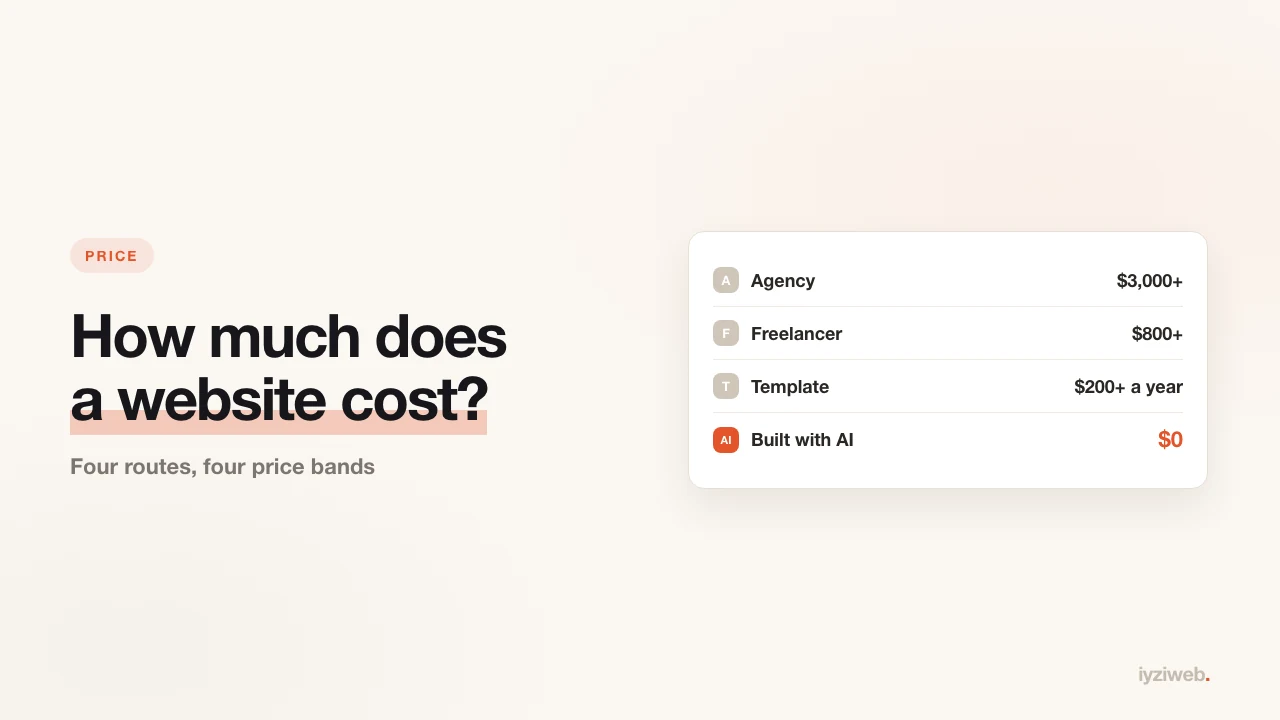
| Route | Typical cost | Time |
|---|---|---|
| Digital agency | $3,000 – $20,000 | 3 – 8 weeks |
| Freelancer | $800 – $5,000 | 2 – 5 weeks |
| Template builder (DIY) | $200 – $700 per year | 1 – 3 days of your time |
| AI site builder | Starts at $0 | Minutes |
These bands are not from one price list. They are the ranges agencies and freelancers publish openly. If you want to check them in your own market, get three quotes and describe the same job every time — otherwise the numbers are not comparable.
1. Agency: most expensive, least effort from you
Most of an agency invoice goes to people, not code. A typical engagement breaks into discovery, design, build, content, testing and handover. Each step has a different person attached, and the price is the sum of those hours.
An agency makes sense in three situations: you need custom software (a booking engine, a membership system, an integration), your brand is being designed from scratch, or you simply want to hand the whole thing off.
Where to be careful: quotes that bundle "website + SEO + social media" into one number hide what the site actually costs. Ask for line-item pricing. A quote you cannot break apart is a quote you cannot compare.
2. Freelancer: price drops, risk moves
The same work done by one person naturally costs less. The real issue here is not price, it is continuity: the person who built your site may not be available six months from now. And if the site was not set up in your name, the domain and hosting account stay with them.
If you go this route, get three things in writing up front:
- Domain and hosting registered in your name, billed to you
- Admin passwords handed over at delivery
- How many revisions are included and what the rate is after that — as a number
When those three are missing, you get the classic outcome: the site works, but you cannot change a phone number without emailing someone.
3. Template builder: looks cheap, you pay in hours
Monthly fees on template platforms look small. But the model hides two costs: your own time, and add-ons. Setup is marketed as "drag and drop"; in practice, writing copy, sourcing images, fixing the mobile layout and making the contact form actually deliver takes days.
The second cost is sneakier. Booking, multiple languages, advanced forms — on most platforms these arrive as paid add-ons. The annual total often lands at two or three times the monthly price you first heard.
4. AI setup: today's lowest band
This is the route that appeared in the last two years: you describe your business in a sentence, and the pages, copy and images come back built. The labour disappears, because the system writes the text and generates the visuals too.
İyziWeb's starter plan is free: no time limit, 40 credits a day, refilled every morning. Hosting, the SSL certificate and maintenance are included — nothing leaves your pocket for the first setup. When you want your own domain and the İyziWeb badge removed, Pro is $15/month, with a domain for the first year, hosting and SSL included. Current numbers always live on the pricing page.
The honest caveat: AI builds a standard business website very well — overview, services, contact, blog, booking hand-off. If you need custom software (a real reservation engine, an ERP integration, a member area), that is still agency work.
Five things the price must include
Whichever route you pick, these five line items should be spelled out in the quote. If they are not written down, they arrive later as an invoice:
- Domain name — how many years, registered to whom
- Hosting — monthly or yearly, and what the renewal price is
- SSL certificate — the padlock in the address bar; free versions exist, so a separate charge is worth questioning
- Mobile layout — if it appears as a separate line, be careful; in 2026 this is table stakes
- After delivery — revisions included, and the monthly maintenance rate
We broke those down one by one in the hidden bill behind a website. Worth reading before you collect quotes.
Is "free" really free?
Honest answer: the money side is zero, the effort side is not. AI builds the site, but you are the one who says what you do, which services you sell, your phone number and your opening hours. And once it is built, you look at it and fix the parts where you think "that isn't quite us".
In practice that is 15 to 20 minutes. An agency discovery call to gather the same information already takes an hour — the difference is who processes it afterwards.
Which route for which situation?
| Your situation | Sensible route |
|---|---|
| Just opened, you want to exist online | Free AI setup |
| Site exists but is old and breaks on phones | Rebuild — repairing an old site is often costlier |
| You need your own domain and a polished look | Pro plan or a freelancer |
| Custom software, integrations, member accounts | Agency |
Frequently asked
What is the cheapest route?
AI setup; the starter plan is free and hosting is included. But "cheapest" is not always
"right" — if you need custom software, price comparison stops being meaningful.
Why are agencies so expensive?
Most of the price is billable hours: designer, developer, copywriter, project manager. A
website is not expensive as code; it is expensive as process.
Can I move it elsewhere later?
If the domain is registered in your name, yes. That is why you ask on day one whose name
the domain goes under. We covered the difference in
domain name or free subdomain.
Can I start free and upgrade later?
Yes, and the site stays the same. Upgrading connects your own domain, so
yourbusiness.com replaces the free subdomain.
In short
The price of a website is set by how much of the work you do yourself. With an agency you do nothing and pay the most; with a template you do everything and pay less; with AI you describe the business and the system builds it.
When collecting quotes, insist on one thing: itemised pricing. Single-number quotes cannot be compared, and the surprises always come out of that single number.