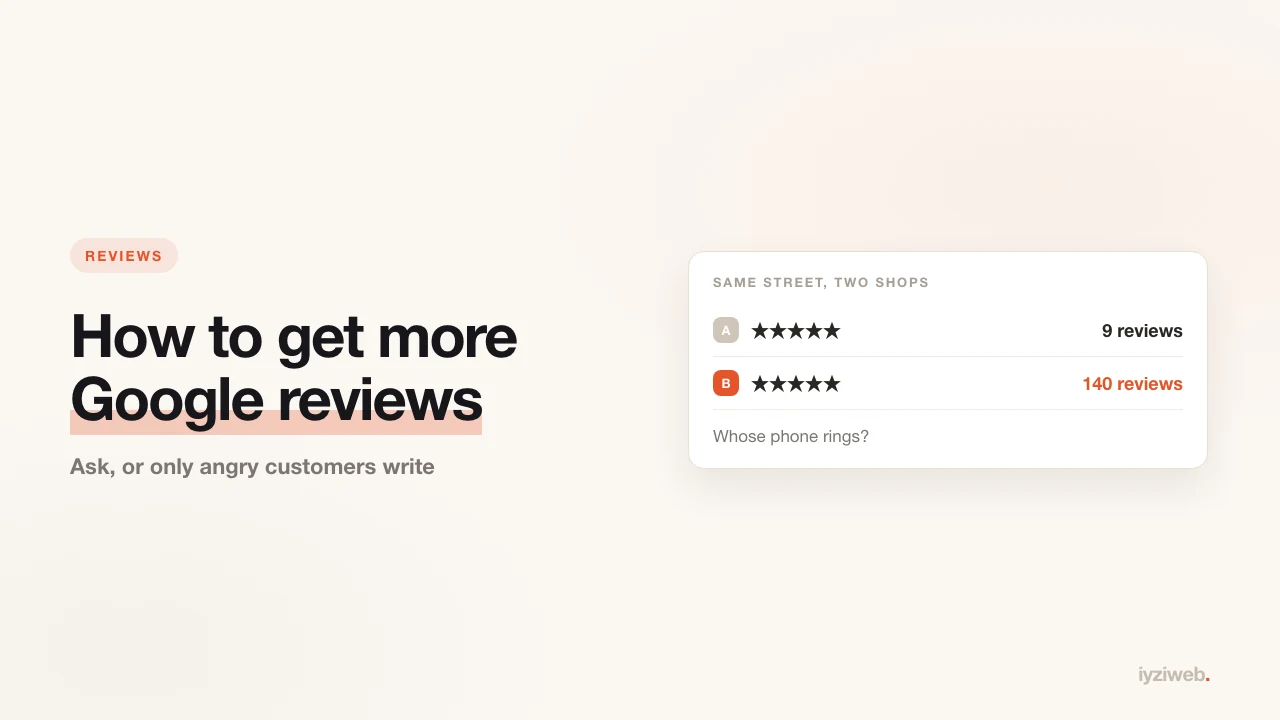
Picture two shops on the same street. Same trade, similar prices. One has 9 reviews on Google, the other 140. It is not hard to guess whose phone rings.
Review count is one of the most direct levers for ranking in Google Maps. But the bigger point is this: reviews are the last thing a person looks at before deciding. Even if you rank first with 3 reviews, the competitor in fourth place with 90 takes the customer.
First, let's settle this: asking is not begging
The biggest obstacle here is not technical, it is psychological. Owners assume asking is pushy. In reality most happy customers never think of leaving a review — they skip it because nobody asked. The unhappy one writes without any prompting.
Which produces a strange imbalance: if you never ask, only the angry customer has a voice. Asking corrects that.
1. Catch the right moment
Timing beats wording. The highest response comes at the moment the customer says out loud that they are happy:
- At the salon, when they get out of the chair, look in the mirror and smile
- At the garage, when the car is handed back and they say "that was quick"
- At the cafe, when they ask for the bill and say "everything was lovely"
- On a service call, when the customer sees the appliance running again
The sentence to use is simple: "If you were happy with it, would you mind leaving two lines on Google? It genuinely makes a difference for a small business like ours."
That last clause matters — people help a person, not a company.
2. Take the friction to zero
"Find us on Google and leave a review" does not work. Searching, finding the right listing, tapping the star — you lose people at every step. Hand them the review link directly.
Inside your Google Business Profile dashboard there is a "Ask for reviews" section with a short link unique to your business. Tapping it opens the star screen immediately. Put that link:
- In a text or WhatsApp message (the highest-converting channel)
- On a QR code by the till
- On your website as a "Leave us a review" button
- Printed on the receipt or invoice
| Method | Response rate | Note |
|---|---|---|
| Verbal request, no link | Very low | Customer forgets |
| Address printed on a card | Low | Typing it is a chore |
| QR code on the table | Medium | Works well in cafes |
| Message right after the job | Highest | Opens in one tap |
3. Ask, but not every customer
Being systematic does not mean asking everyone. Asking for a review after a day that went badly is handing someone a loaded gun. Ask the customer whose satisfaction is obvious; for everyone else ask "was everything alright?" first. If the answer is yes, move to the review. If not, fix the problem first.
4. Answer bad reviews — without defending
A bad review does not sink a business. An unanswered bad review does. New customers read it and watch how you behaved.
The reply pattern that works has three parts:
- Acknowledge: "I'm sorry that happened, and you're right."
- Say what you did: "We talked it through as a team — we booked the slots too tightly that day."
- Leave the door open: "We'd like to put it right; call us on 555-0134."
What not to do: argue with the customer, claim "this person was never here", or leave copy-paste one-liners under every review.
5. Give the job to one person
"Everyone should ask" means nobody asks. Make one person responsible and track a single number at the end of the day: how many people we asked. Not how many reviews arrived — asking is in your control, writing is theirs.
A shop that asks 20 people a week collects roughly 15-25 new reviews a month. That is around 200 a year, which is more than most competitors have in total.
6. Ask for photos too
Reviews with photos get read more and enrich the profile. The colour after a salon visit, before-and-after on a repair, the plate at a cafe — if the customer already took the photo, "could you add that to the review too?" is enough.
Your own photos do the same job; how to shoot them is in taking business photos with your phone.
7. Bring the reviews onto your site
A review on Google stays on Google. But someone landing on your site needs the same reassurance. Show three or four real reviews on your homepage with the name and date. Never invent them — people can tell, and one fake review makes the whole page suspicious.
Things that will get you suspended
- Buying reviews. When Google detects a fake review network the reviews get deleted, and repeat offences suspend the profile. You lose the map listing, not just the reviews.
- Discounts in exchange for reviews. Explicitly against the rules. Signs offering "10% off if you review us" get reported.
- Filtering for five stars only. "Ask us first, and go to Google if you're happy" funnels are banned too.
- Writing reviews from your own phone. Reviews from the same device and location get flagged.
Do reviews really affect ranking?
Google openly names three factors for local ranking: relevance (what you do), distance (how far you are from the searcher) and prominence (how well known you are). Review count and rating count directly toward the third.
You cannot change distance, and you set relevance once. The only variable you can move continuously is reviews — which makes this the highest-return work available.
In short
Collecting reviews is a habit, not a campaign. Ask at the right moment with a one-tap link; reply to everything that comes in; track the number weekly. Three months later you will see your position on Maps has moved.
The next step is having somewhere for those readers to land. However good your profile is, if the click does not reach a website the conversation ends there. We covered how the two work together in how do I show up on Google, and adding your business to Maps covers setting the profile up from scratch.