Ask a small business owner without a website why they do not have one, and the most common answer is not technical: "I don't know what to write."
It is a fair worry, because every site they look at for reference opens the same way: "Founded in 1998, our company has made customer satisfaction its guiding principle, delivering quality service…" That sentence says nothing and persuades nobody to pick up the phone.
The trick to good website copy is not literary. There is one rule: answer the question in the customer's head, in the order they ask it.
What is the visitor asking?
Every visitor asks the same five questions in order without realising it. The site's job is to answer them top to bottom:
- What does this business do?
- Is it right for me?
- Can I trust them?
- What will it cost?
- How do I get in touch?
Sites that break the order lose. The most common error: starting on "About Us" before answering question one.
Homepage: the first three lines decide everything
The visitor decides whether to stay at the very top of the page. Three things belong there: what you do, where you do it, what they should do next.
The pattern:
[What] in [where]. [For whom / in what situation]. [What to do].
| Weak | Strong |
|---|---|
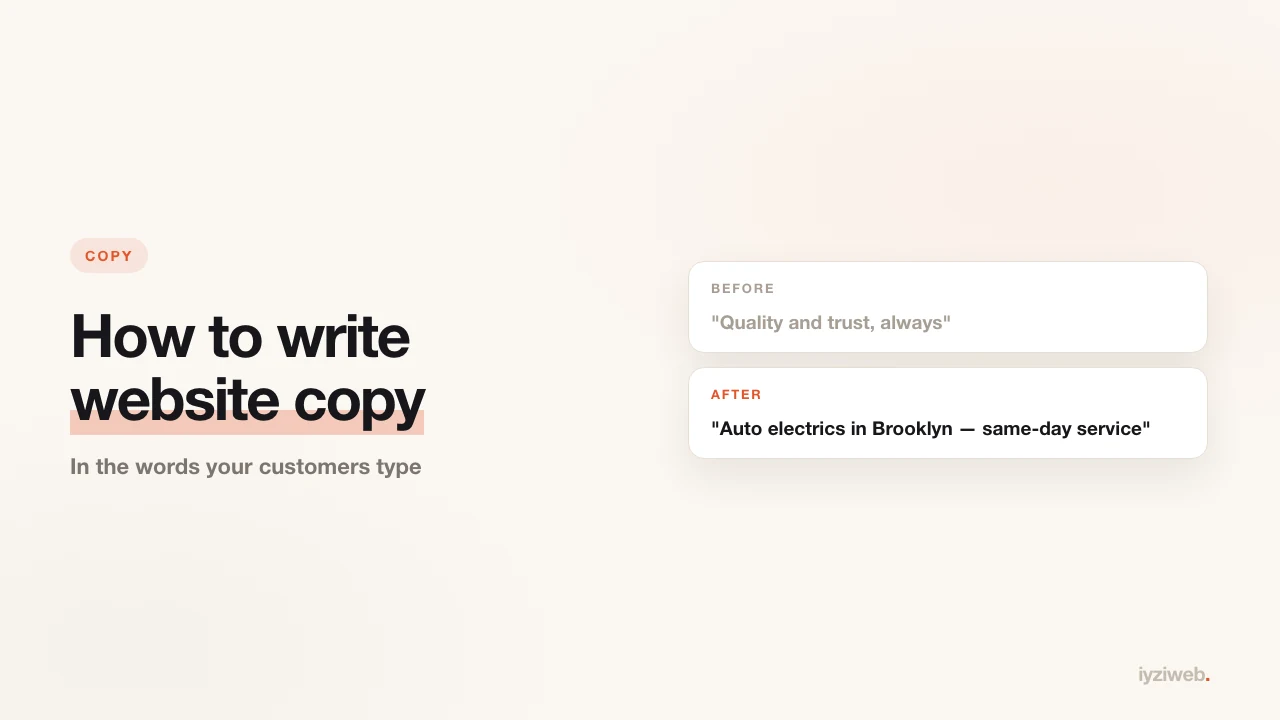
| Delivering quality service, always by your side | Boiler and AC service in Brooklyn. Same-day call-outs. |
| Customer satisfaction is our priority | Rug cleaning in Queens. We collect, we clean, we deliver. |
| Your professional solution partner | CNC machining in Sheffield. From prototype to production runs. |
Below it, a single button: Call or Message us. Do not offer five options; clicks fall as choices multiply.
Services: write answers, not a list
Most sites list services as bullets: "Boiler servicing, AC installation, radiator flushing". That is weak both for Google and for the customer. Add two sentences to each service: when it is needed and how long it takes.
Example:
"Radiator flushing. If your radiator is hot at the bottom and cold at the top, sludge has built up inside. The job takes two to three hours and you can use the system the same day."
Those two sentences do three jobs at once: the customer recognises their own situation, the uncertainty about duration disappears, and your page can surface for searches like "radiator cold at top hot at bottom".
About: not a CV, a trust page
Nobody wonders about your founding date. What they wonder is who does this work.
Three things suffice:
- Who you are and how long you have done this (one sentence)
- A photograph — of you or the team
- One concrete detail: how many jobs, which brands you work with, what you are certified in
Everyone writes "20 years of experience". Only someone who actually did it can write "over 400 boiler services in the last three years". The second one works.
Pricing: give a range even if you cannot give a number
Not publishing prices feels safe but has a cost: your phone rings constantly with "how much is it", and most of those calls do not convert.
If you cannot commit to a price, give a band: "Boiler servicing runs $90-150 depending on the unit; we confirm the exact figure on the phone." That one sentence filters out the empty calls and removes the suspicion of hidden pricing.
Contact: make everything tappable
Do not put the phone number in as plain text. On a phone, tapping it should start the call. The same applies to the address: it should open a map.
What the page needs: phone, messaging link, address with map, opening hours. Opening hours are searched surprisingly often, and sites that omit them lose that traffic.
Six rules while writing
- Write "you", not "our company". Customers want to read about themselves.
- Keep sentences short. One idea per sentence.
- Use numbers. Not "fast" but "same day"; not "affordable" but "from $90".
- Swap adjectives for evidence. Instead of "the best", a customer review.
- Be local. Name the town and neighbourhood — for customers and for Google.
- End every page with an action. Call, message, book.
If you are having AI write it
Having AI write the copy is not a bad idea, but left alone it produces text that reads like everyone else's. The method that works: you supply the raw material, it does the shaping.
The raw material: what you do, which area, who the typical customer is, the three most common questions, your price band, how long you have done this. Without those six the output stays hollow — we went into that distinction in building a website with AI.
Once the words are done, the images are what is left — taking business photos with your phone closes that gap.
Three checks before you finish
- Show the page to someone who does not know you and ask what this business does. If they cannot answer in five seconds, the top section is weak.
- Open it on a phone. Is the text readable, are the buttons thumb-sized?
- Read your own copy aloud. Delete any sentence you would not say in conversation.
In short
Good website copy is not beautifully written copy; it is copy that answers in the order the customer asks. Say what you do in the first line, explain services with examples, give a price band, end every page with an action. Ornate sentences are not needed — they actively hurt.
If you are still unsure whether a site is worth it, why your small business needs a website is a good place to start.